TECC 2020: These 3 ideas emerged from the entrepreneurship programme
At the Training On Entrepreneurship & Company Creation (TECC), three new business ideas were developed, which have now been presented at a final pitch event.
The Corona crisis taught that the environment around us can change very quickly and we need to be more flexible and to constantly adapt our mindset to different situations, trying to catch new opportunities.
In such a complex environment, educational institutions and organizations are today closer than ever. They are working together to train young students, providing them with the skills and competences necessary to face the challenges of the future.
TECC – Training On Entrepreneurship & Company Creation – is an example of how universities and organizations can cooperate through innovative training formats which ehance the transfer of knowledge and the development of both hard and soft skills.
Students develop their own startup ideas with TECC
At the beginning of March 2020, the Institute for International Management at FH JOANNEUM together with its partners AVL List, Raiffeisenlandesbank Steiermark and 360Lab launched TECC (Training On Entrepreneurship & Company Creation), a new training program focused on the development of entrepreneurial skills and practical knowledge within the university.
„With the TECC training programme, we want to give students, together with our partners, both the theoretical basics as well as the mindset and our entrepreneurial spirit, so that they develop the tools they need to react flexibly to future challenges and find innovative solutions as founders or entrepreneurs in the company,“ says AVL at Raiffeisen Landesbank Steiermark again emphasises the concern to promote creativity and innovation in the Styrian economy: „Qualities that are in great demand – in times of crisis all the more so. Young people who invest their energy in innovation are shaping the world of tomorrow and contribute with their ideas and implementation to the future of Styria as a business location“.
During these months, the teams have worked hard on the development of their projects, facing always new challenges and issues related to their potential markets. Partners have supported each team through coaching and mentoring sessions where students had the chance to get some practical insights about the startup and corporate’s world.
„We are very proud to be able to implement this entrepreneurship training at FH JOANNEUM together with our corporate partners“, says Doris Kiendl, FH JOANNEUM, about the programme: „The general conditions are of course difficult at the moment, but it has been shown that even in virtual space thoughts can sparkle and that entrepreneurial ideas can be worked on with fun and energy. This gives our students very important additional skills.
„Especially in challenging times, innovative ideas and passionate people are needed to make them become reality. We are very pleased to support students within the framework of TECC, together with our partners. With proven tools, our experience and expertise we want to prepare the next generation of entrepreneurs for this journey“, says also the team of the 360 Innovation Lab
Three business ideas as a result of TECC
The project involves students from different courses of study who have the motivation to develop their own business ideas and to acquire the necessary skills. During the program, students have attended online lectures and meetings with professors and experts in the fields of business development, business modeling and business planning. As result, they came up with three business ideas in different sectors and with the creation of multidisciplinary teams.
These are the three Teams
Manuel Karner, Fabienne Burger, Sara Maria Oberleitner, Andreas Kollmann:
„We are DigiBills, a startup which aims to revolutionize receipts and digitalize them. We wanna create a more sustainable everyday life and improve the availability and categorization of receipts. Our app will provide a throughout solution for customers and businesses alike. Our team appreciates especially the possibility and guidance throughout the testing phase and selection of possible MVPs.“
Sandra Fröhwein, Anton Heidinger, Carolin Kobierski, Stefanie Lukas, Christina Niederl:
„We are BAUERPUMPkin and our mission is to offer local produced protein bars to health-conscious people. We want to create a fitness snack that does not only support local farmers but also offers a tasty alternative to artificial shakes. TECC helped us to realize that any idea can lead to great success. You just need to believe in your dreams and be agile – because the first idea does not have to be the last one! Constant changing and adapting is key and what we also learned: it is ok to fail – because you will come back stronger.“
Ivana Civsa, Collasius Yannick, Rothschädl Markus, Schadinger Julia, Waltenstorfer Tobias:
„Our project is called afloAT and it’s a platform that connects companies with highly skilled individuals who do not speak the local language. What’s in it for them? For the companies we are filtering out the best candidates for the job posted, and for candidates we are providing consultancy services in terms of reviewing the application documents, CVs etc.; What TECC told us (amongst so many things!) is that even when nobody believes in your idea at first, you can work on it and prove everyone wrong because you adapt it your potential customer’s needs and show that any idea can be feasible.“
Presentation of the start-up ideas at a pitch event
The first semester was closed with the Final Pitch Event which took place on 23rd June 2020 at FH JOANNEUM. During the final event, each team had around 5 minutes to pitch its business idea and to convince guests that it could become a business opportunity.
The students showed to the audience how they have structured their business models and how they have built and validated their first MVP (Minimum Viable Product). The pitches were evaluated by a jury of four experts. At the end, the students received a feedback on the basis of the criteria of value proposition, market potential, innovation, business model, design of the presentation and pitch.
The event was also an opportunity to exchange valuable experience concerning the collaboration between corporates and institutions as way to enhance innovation and to spread the entrepreneurial culture.
Slideshow: The highlights of the TECC closing event
Funktion statt nur Funkeln: Wie Swarovski in Wattens Innovation organisiert
Die Marke kennt jeder, die Fertigung dahinter kaum jemand. In Wattens will Swarovski aus 130 Jahren Glas-, Schleif- und Beschichtungskompetenz neue Geschäftsfelder machen. Head of Technology & Innovation Gerhard Schwarz und Head of Innovation Simon Laubscher erklären bei einem Besuch von brutkasten in Wattens, warum Innovation bei ihnen direkt an der Fertigung sitzt und weshalb ein Stopp kein Scheitern ist.
Funktion statt nur Funkeln: Wie Swarovski in Wattens Innovation organisiert
Die Marke kennt jeder, die Fertigung dahinter kaum jemand. In Wattens will Swarovski aus 130 Jahren Glas-, Schleif- und Beschichtungskompetenz neue Geschäftsfelder machen. Head of Technology & Innovation Gerhard Schwarz und Head of Innovation Simon Laubscher erklären bei einem Besuch von brutkasten in Wattens, warum Innovation bei ihnen direkt an der Fertigung sitzt und weshalb ein Stopp kein Scheitern ist.
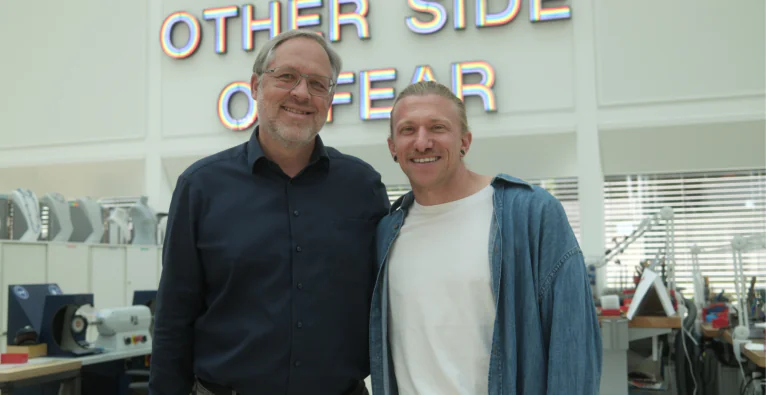
Gerhard Schwarz (l.), Head of Technology & Innovation, und Simon Laubscher, Head of Innovation, am Swarovski-Standort in Wattens. | Foto: Martin Pacher | brutkasten
Hoch an der Wand der Halle hängt ein Satz in verspiegelten Lettern: „Everything you want is on the other side of fear.“ Darunter, auf hellem Holzboden, Werkbänke, eine Fräsmaschine, Vitrinen mit Kristallapplikationen, Bildschirme, Prototypen, eine Sitztreppe mit bunten Polstern. Links, hinter einem Gitter, eine größere Anlage. Von einem Fenster im Gebäude geht der Blick über die Werksdächer auf die Felswände des Karwendels. Wattens, Tirol, ein Freitagmorgen im September.
Der Ort heißt Swarovski Manufaktur. Das Unternehmen beschreibt sie als Kreativ- und Innovationsort am Standort Wattens, der Design, Handwerk, Forschung und Fertigung unter einem Dach vereint. Hier arbeitet der B2B-Entwicklungsbereich von Swarovski: Textil, Mode, Sonderlösungen, Mobility. Es geht um die Applikation von Kristall auf Stoffe, auf T-Shirts, in allen möglichen Formen.
Im selben Raum sitzen Kolleginnen und Kollegen aus der internen Schmuckentwicklung und dem Prototyping. Und hier werden auch Kristalle geschliffen. Neben einer Fräseinheit steht eine selbst entwickelte Einheit. Maschinen, die Kristall schleifen und polieren, gibt es auf keinem Markt zu kaufen. Swarovski war nach eigener Darstellung lange einer der größten Maschinenbauer und ist heute Maschinenentwickler. Bestimmte Komponenten dieser Maschinen gelten im Haus als das, was die Einzigartigkeit des Unternehmens in den vergangenen 130 Jahren ausgemacht hat. Deshalb wird dieses Know-how geschützt, Fotografieren ist nur in bestimmten Bereichen erlaubt.
Wie das Produkt entsteht, lässt sich an ein paar Objekten nachvollziehen. Ein Glasrohling, mit Anguss und Körper, so wie er aus der Form kommt. Am Anfang steht das Wissen um die Ingredienzien und ihre Zusammensetzung, dann die Schmelze und das Umformen. Durch erneutes Erhitzen lässt sich aus einer Farbe eine andere machen. Dann wird der Rohling auf Werkzeugaufspannungen geschliffen und poliert, bis er funkelt. Kleiner als ein Millimeter ist das kleinste Format, 40 Zentimeter das größte. Zuletzt die Frage, ob die Oberfläche noch einen Effekt braucht: hinten verspiegelt, oder komplett beschichtet, dann sieht derselbe Kristall völlig anders aus. Höchste Transparenz, präzise Bearbeitung, optische Veredelung: Verfahren, die es im Grundprinzip auch in der Hochtechnologie gibt, hier eingesetzt für den Effekt. Und inzwischen auch für eine Funktion.
(c) Martin Pacher / brutkasten
Was das bedeutet, erklären an diesem Vormittag zwei Männer. Gerhard Schwarz, gelernter Physiker, ist Head of Technology & Innovation bei Swarovski. Sein Bereich umfasst Produkttechnologie, also die Technologie für die Produkte selbst, vom Schmuck bis zu den neuen Zweigen wie Automotive und Mobility, und Produktionstechnologie, also das, was diese Produkte in die Fertigung bringt, als Eigenentwicklung oder gemeinsam mit Partnern. Simon Laubscher, zuvor in der Automobil- und Elektronikindustrie tätig, ist seit einem Jahr Head of Innovation, unter Schwarz‘ Verantwortung, mit Schwerpunkt B2B. Seine Aufgabe: aus dem, was das Fertigungsumfeld an Fähigkeiten hervorbringt, neue Felder identifizieren und aufbauen.
Wo das endet, sagt Schwarz gleich zu Beginn: „Wir identifizieren Geschäftspotenziale, erarbeiten daraus Businesskonzepte und validieren diese mit Kunden am Markt. Auf dieser Basis prüfen wir, ob ein marktfähiges Produkt oder ein Service entstehen kann. Die Entscheidung, ob und wie diese Geschäftsfälle anschließend umgesetzt werden, liegt schlussendlich beim Top-Management.“ Es ist eine Grenze, die man kennen muss, um zu verstehen, worüber die beiden sprechen und worüber nicht.
Schön und Funktion
Swarovski kennt man als Marke, vom Schmuck, von den Figurinen, vom Endkunden. Das ist das B2C-Geschäft. Das B2B-Geschäft, so Schwarz, geht an Kunden, die die Artikel weiterverarbeiten: in Schmuck, in Textil, aber auch in der Automobilindustrie. Und genau dort beginnt, was die Innovationsabteilung interessiert. „Man kennt Kristall mit seiner funkelnden Wirkung. Da gehen wir einen Schritt weiter, da haben wir funktionale Wirkung. Ich tippe auf einen Kristall, und das ist dann ein Schalter.“ Kristallglas an sich kann das nicht. Mit einer optischen Schicht kann es das. Lichtleitung sei eine zweite solche Funktion, „neben schön“.
„Innovation ist ein sehr standardisierter Prozess. Er ist sehr klar, sehr strukturiert und folgt gewissen Regeln.“ | Simon Laubscher
Die Kombination aus dekorativ und funktional sei im Automotive-Bereich ein Erfolgsmodell geworden, sagt Laubscher. Jetzt gehe es darum, in welche anderen Segmente sich das übertragen lässt. Man sei in der Validierung, teste an verschiedenen Kundensegmenten, was einen Mehrwert bringen kann. Der Schwerpunkt liege derzeit auf der Hightech-Branche, weil man dort den Vorteil aus Material, Fertigungs- und Technologiekompetenz sieht.
Warum Innovation in der Forschung sitzt
Bei vielen Konzernen sitzt die Innovationsabteilung losgelöst vom Rest, manchmal an einem anderen Ort. Bei Swarovski nicht. Innovation ist Teil der Forschung, und der Grund dafür ist die enge Verzahnung mit der Technologie. Forschung und Entwicklung auf der einen Seite, Technologie und Innovation (T&I) auf der anderen: Bei Swarovski ist das eines. Die Organisation ist projektorientiert, das Innovationsportfolio fließt mit dem Gesamtportfolio zusammen, Personal wird über die Portfolioplanung den Projekten zugeordnet.
Simon Laubscher | (c) Martin Pacher / brutkasten
Für Laubscher war das ein Grund, nach Wattens zu kommen. 15 Jahre hat er sich in anderen Unternehmen mit Innovation beschäftigt und hat, wie er sagt, einen Überblick darüber, was funktioniert und was nicht. „Ein schlagendes Argument für mich bei Swarovski war: Man sitzt sehr nah an dieser Kompetenz.“ Im Englischen nennt er das Capability-led Approach. Die Fähigkeit bestimmt, wo innoviert wird.
Und diese Fähigkeit hat einen Ort. „Wir sitzen sehr tief in der Wertschöpfungskette“, sagt Laubscher. „Wir schmelzen unser eigenes Glas, wir prozessieren es, wir schleifen, wir polieren, wir veredeln es mit Beschichtungen und haben dann eine fertige Komponente.“ Alles an einem Standort, aus einem Guss, bis hin zu den selbst entwickelten Maschinen, die in der Halle stehen. Technologieentwicklung und Maschinenentwicklung, sagt Schwarz im Gespräch, mache man zum Teil selbst, zum Teil mit Partnern.
Pull, Push und ein Trichter
Wie kommt eine Idee bei Swarovski ins Portfolio? Es gibt zwei Wege. Laubscher beschreibt den ersten, Schwarz wird ihn später Pull nennen: explorativ Zukunftstrends und Technologien anschauen, dann relativ schnell prüfen, ob es einen Fit zur eigenen Fähigkeit gibt. „Haben wir ein Recht mitzuspielen, also das berühmte Right to Play.“ Danach der Technologie-Check, dann der Markt-Check: Gibt es potenzielle Kunden, und sind sie bereit, für den Mehrwert zu zahlen? „Dann ist das für uns schon eine gute Indikation.“
Der zweite Weg, Push, kommt von innen. „Jeder liest, jeder sieht Trends“, sagt Schwarz. Die Technologieexperten im Haus melden, was etwas sein könnte, und das landet im Technologieradar. Keine Ideendatenbank über alle, betont er, sondern Experten, wobei Ideen einzelner Mitarbeiter ebenfalls willkommen seien. Ergänzt wird das inzwischen von KI-Agenten, die das Netz nach Trends absuchen. Ein Spezialist bestätigt, dann kommt es aufs Radar. Und dann gibt es noch den ganz rudimentären Weg, wie Schwarz sagt: „Man trifft sich und spricht.“
KI spielt auch in der Fertigung eine Rolle, aber Schwarz bleibt nüchtern. „Im Prozessbereich ist es früher Regelungstechnik gewesen.“ Jetzt verarbeite man mehr Daten, halte Temperatur und Mechanik genauer, werde schneller. Und in der Maschinensoftware, die Swarovski teils selbst, teils mit Partnern entwickelt, gehe es mit KI-Einsatz ebenfalls schneller. Laubscher ergänzt aus Innovationssicht: Die Recherche werde deutlich kürzer, aber „am Ende des Tages kriege ich eine Liste von Annahmen. Die Annahmen muss ich testen.“ Am Kunden. „Die künstliche Intelligenz bringt Geschwindigkeit. Das Tun und das Machen liegt im Menschen.“ Man arbeite in einem festgelegten, geschützten Cloud-Rahmen, den die Digital-Abteilung vorgibt.
Gerhard Schwarz | (c) Martin Pacher / brutkasten
Was über beide Wege ins Portfolio kommt, muss durch einen Trichter. Stages und Gates, an denen gefragt wird, wo das Projekt steht und wie es sich am Ende materialisiert. Im Kerngeschäft oder außerhalb? Das entscheidet sich fallweise in Portfolio-Meetings mit dem Topmanagement. „Wichtig ist Disziplin, diese Stages, und Transparenz“, sagt Schwarz. Jedes Projekt ist gelistet, offen einsehbar, auch für die Nachbarabteilungen. Controlling, Produktentwicklung und Produktmanagement sitzen im Portfolio-Steering-Team.
Laubscher wehrt sich gegen ein Missverständnis: „Innovation wurde gerade im Hype 2013, 2014 immer verwechselt mit kreativen Prozessen. Innovation ist ein sehr standardisierter Prozess. Er ist sehr klar, sehr strukturiert und folgt gewissen Regeln.“ Eines seiner Key Learnings nach einem Jahr: die Kollegen aus der Linie früh einbinden, umso früher, je näher ein Thema am Kerngeschäft liegt. Damit das, was als Potenzial identifiziert wurde, am Ende auch übergeht und man nicht genau dort stoppt, wo man schnell sein will.
Ein Stopp ist kein Scheitern
Der Satz, der an diesem Vormittag am häufigsten fällt, lautet: Innovation ist kein Selbstzweck. „Innovation muss am Ende auch rentabel sein, damit wir langfristig erfolgreich sind“, sagt Laubscher. Das heißt auch: „Nicht alles geht weiter. Wir müssen ganz klare Stopps setzen.“ Gestoppt wird, wenn eines von drei Themen nicht abgedeckt werden kann: Technologie, Markt, Kunde und dessen Bedarf. „Da müssen wir ganz klar und ehrlich zu uns sein.“ Ob man darin noch besser werden könne? „Sicherlich, das kann jede Organisation.“
Aber: „Ein Stopp ist kein Scheitern.“ Prozesswissen bleibe hängen, was für einen Kunden nicht funktioniere, könne für einen anderen laufen. Der größte Erfolgsfaktor sei, so schnell wie möglich am Kunden zu sein. „Nicht in unserer Bubble zu bleiben. Wir wollen nach außen hin eine Klarheit haben, auch wenn das manchmal wehtut, das ehrliche Feedback.“
Niemand kann alles
Beim Thema Partnerschaften wird Laubscher grundsätzlich. „Der Punkt ist: Niemand kann alles.“ Der Aufbau eines Innovationsökosystems sei Teil der strategischen Initiative aus der Innovation heraus: Vernetzung mit Industriepartnern, Startups, Universitäten. Wie, das entscheide sich von Fall zu Fall. Universitäten für Ideen und Forschungsthemen, Startups für Technologieerweiterungen. Schwarz sieht darin auch eine Frage der Einschätzung: Weil Swarovski Technologie so breit einsetze, könne man die Technologien von Startups gut beurteilen. „Man muss einschätzen können: Was ist der gemeinsame Nutzen?“
„Innovation muss am Ende auch rentabel sein, damit wir langfristig erfolgreich sind.“ | Simon Laubscher
Beteiligungen? „Grundsätzlich sind wir für alles offen“, sagt Laubscher, es lasse sich aber nicht pauschal beantworten. Wer welche Fähigkeit oder welche IP einbringe, bestimme das Modell. Wichtig sei der Bezug zur eigenen Technologie. „Nicht in einem Bereich schwimmen, der uns fremd ist, nur weil es ein Trendthema ist.“ Schwarz formuliert es so: „Für mich legt der Inhalt immer das Beteiligungsmodell fest.“ Auch IP wird von Fall zu Fall geregelt: ablösen über Bezahlung, beim Partner belassen oder lizenzieren. Die Rechtsabteilung, sagt Schwarz, denke da sehr innovativ mit.
Was Swarovski in eine solche Partnerschaft einbringt, ist für Laubscher klar: „Wir sind Industrialisierungsexperten. Wir haben industrialisierte Prozesse, wir haben das Know-how, und wir können skalieren.“ Das habe man 130 Jahre lang bewiesen, so habe die Geschichte des Unternehmens begonnen. Schwarz: „Die Firmengründung war eine technische Innovation.“
(c) Martin Pacher | brutkasten
Nach außen ist man aktiv, auf Veranstaltungen, bei denen Startups pitchen, und an Universitäten im DACH-Raum. Und an der EPFL in Lausanne. „Die EPFL ist für mich sehr innovativ, weil diese Loslösung von der Universität dort besser stattfindet als woanders“, sagt Schwarz. Entrepreneurship sei dort ein großer Schwerpunkt, ergänzt Laubscher, man bekomme früh Transparenz, was an der Universität läuft. Und Innsbruck, wo Quantentechnologie ein Schwerpunkt ist? „Muss man sich anschauen“, sagt Schwarz. Mit der Universität und dem MCI gibt es Zusammenarbeit, Master- und Diplomarbeiten, die in Lösungen eingeflossen sind.
Und wenn ein Gründer diesen Text liest und eine Lösung hat? Schwarz nennt eine Mailadresse ([email protected]), Laubscher ergänzt: „Gerne direkt schreiben.“ Schwarz: „Oder LinkedIn.“ Es seien die Menschen, die entscheiden, sagt er. Man müsse nicht formalisieren, was sich einfach lösen lässt.
Aus Bruch wird Produkt
Ein Beispiel, bei dem Fähigkeit und Geschäftsmodell bereits zusammengefunden haben, sind die ReCreated Kristalle. Wenn die Glasschmelze anläuft, hat das Glas nicht sofort die nötige Qualität. Es entsteht Anlaufglas, Bruch, der eingeschmolzen werden müsste. Bis jemand die Idee hatte, damit anders umzugehen. „Eigentlich könnte ich das upcyceln, wieder ein Produkt draus machen und in die Farbglasproduktion reingehen“, sagt Schwarz. Heute ist das eine eigene Produktlinie für B2B und B2C. „Kommt beim Kunden sehr gut an.“
Für Laubscher schließt sich hier der Kreis. Chemische Verfahrenstechnik sei das Know-how des Hauses, also frage man, aus welchem Materialstrom ein Wertstrom werden kann, und diskutiere früh über Geschäftsmodelle. Meist mit Partnern, weil erst dann Synergie entstehe. „Es darf nicht zum Selbstzweck passieren“, sagt er auch hier. „Aber wenn aus der Nachhaltigkeit ein Geschäftsmodell entsteht, ist das für uns ein Punkt, auf den wir aufspielen wollen.“
Am Ende des Gesprächs sagt Laubscher, worum es ihm geht: „Wir sind ein Unternehmen mit einem sehr einzigartigen Produkt. Für uns ist es wichtig, als Innovation relevant zu bleiben und diese Einzigartigkeit immer wieder neu zu finden, in neuen Themen.“ Innovation werde hier nicht aus Spaß betrieben, sondern mit Seriosität. Und, sagt er nach einem Jahr in Wattens: „Es macht viel Spaß.“
Aktuelle Nachrichten zu Startups, den neuesten Innovationen und politischen Entscheidungen zur Digitalisierung direkt in dein Postfach. Wähle aus unserer breiten Palette an Newslettern den passenden für dich.
TECC 2020: These 3 ideas emerged from the entrepreneurship programme
Manuel Karner, Fabienne Burger, Sara Maria Oberleitner, Andreas Kollmann:
„We are DigiBills, a startup which aims to revolutionize receipts and digitalize them. We wanna create a more sustainable everyday life and improve the availability and categorization of receipts. Our app will provide a throughout solution for customers and businesses alike. Our team appreciates especially the possibility and guidance throughout the testing phase and selection of possible MVPs.“
Sandra Fröhwein, Anton Heidinger, Carolin Kobierski, Stefanie Lukas, Christina Niederl:
„We are BAUERPUMPkin and our mission is to offer local produced protein bars to health-conscious people. We want to create a fitness snack that does not only support local farmers but also offers a tasty alternative to artificial shakes. TECC helped us to realize that any idea can lead to great success. You just need to believe in your dreams and be agile – because the first idea does not have to be the last one! Constant changing and adapting is key and what we also learned: it is ok to fail – because you will come back stronger.“
Ivana Civsa, Collasius Yannick, Rothschädl Markus, Schadinger Julia, Waltenstorfer Tobias:
„Our project is called afloAT and it’s a platform that connects companies with highly skilled individuals who do not speak the local language. What’s in it for them? For the companies we are filtering out the best candidates for the job posted, and for candidates we are providing consultancy services in terms of reviewing the application documents, CVs etc.; What TECC told us (amongst so many things!) is that even when nobody believes in your idea at first, you can work on it and prove everyone wrong because you adapt it your potential customer’s needs and show that any idea can be feasible.“
AI Kontextualisierung
Welche gesellschaftspolitischen Auswirkungen hat der Inhalt dieses Artikels?
Leider hat die AI für diese Frage in diesem Artikel keine Antwort …
TECC 2020: These 3 ideas emerged from the entrepreneurship programme
Manuel Karner, Fabienne Burger, Sara Maria Oberleitner, Andreas Kollmann:
„We are DigiBills, a startup which aims to revolutionize receipts and digitalize them. We wanna create a more sustainable everyday life and improve the availability and categorization of receipts. Our app will provide a throughout solution for customers and businesses alike. Our team appreciates especially the possibility and guidance throughout the testing phase and selection of possible MVPs.“
Sandra Fröhwein, Anton Heidinger, Carolin Kobierski, Stefanie Lukas, Christina Niederl:
„We are BAUERPUMPkin and our mission is to offer local produced protein bars to health-conscious people. We want to create a fitness snack that does not only support local farmers but also offers a tasty alternative to artificial shakes. TECC helped us to realize that any idea can lead to great success. You just need to believe in your dreams and be agile – because the first idea does not have to be the last one! Constant changing and adapting is key and what we also learned: it is ok to fail – because you will come back stronger.“
Ivana Civsa, Collasius Yannick, Rothschädl Markus, Schadinger Julia, Waltenstorfer Tobias:
„Our project is called afloAT and it’s a platform that connects companies with highly skilled individuals who do not speak the local language. What’s in it for them? For the companies we are filtering out the best candidates for the job posted, and for candidates we are providing consultancy services in terms of reviewing the application documents, CVs etc.; What TECC told us (amongst so many things!) is that even when nobody believes in your idea at first, you can work on it and prove everyone wrong because you adapt it your potential customer’s needs and show that any idea can be feasible.“
AI Kontextualisierung
Welche wirtschaftlichen Auswirkungen hat der Inhalt dieses Artikels?
Leider hat die AI für diese Frage in diesem Artikel keine Antwort …
TECC 2020: These 3 ideas emerged from the entrepreneurship programme
Manuel Karner, Fabienne Burger, Sara Maria Oberleitner, Andreas Kollmann:
„We are DigiBills, a startup which aims to revolutionize receipts and digitalize them. We wanna create a more sustainable everyday life and improve the availability and categorization of receipts. Our app will provide a throughout solution for customers and businesses alike. Our team appreciates especially the possibility and guidance throughout the testing phase and selection of possible MVPs.“
Sandra Fröhwein, Anton Heidinger, Carolin Kobierski, Stefanie Lukas, Christina Niederl:
„We are BAUERPUMPkin and our mission is to offer local produced protein bars to health-conscious people. We want to create a fitness snack that does not only support local farmers but also offers a tasty alternative to artificial shakes. TECC helped us to realize that any idea can lead to great success. You just need to believe in your dreams and be agile – because the first idea does not have to be the last one! Constant changing and adapting is key and what we also learned: it is ok to fail – because you will come back stronger.“
Ivana Civsa, Collasius Yannick, Rothschädl Markus, Schadinger Julia, Waltenstorfer Tobias:
„Our project is called afloAT and it’s a platform that connects companies with highly skilled individuals who do not speak the local language. What’s in it for them? For the companies we are filtering out the best candidates for the job posted, and for candidates we are providing consultancy services in terms of reviewing the application documents, CVs etc.; What TECC told us (amongst so many things!) is that even when nobody believes in your idea at first, you can work on it and prove everyone wrong because you adapt it your potential customer’s needs and show that any idea can be feasible.“
AI Kontextualisierung
Welche Relevanz hat der Inhalt dieses Artikels für mich als Innovationsmanager:in?
Leider hat die AI für diese Frage in diesem Artikel keine Antwort …
TECC 2020: These 3 ideas emerged from the entrepreneurship programme
Manuel Karner, Fabienne Burger, Sara Maria Oberleitner, Andreas Kollmann:
„We are DigiBills, a startup which aims to revolutionize receipts and digitalize them. We wanna create a more sustainable everyday life and improve the availability and categorization of receipts. Our app will provide a throughout solution for customers and businesses alike. Our team appreciates especially the possibility and guidance throughout the testing phase and selection of possible MVPs.“
Sandra Fröhwein, Anton Heidinger, Carolin Kobierski, Stefanie Lukas, Christina Niederl:
„We are BAUERPUMPkin and our mission is to offer local produced protein bars to health-conscious people. We want to create a fitness snack that does not only support local farmers but also offers a tasty alternative to artificial shakes. TECC helped us to realize that any idea can lead to great success. You just need to believe in your dreams and be agile – because the first idea does not have to be the last one! Constant changing and adapting is key and what we also learned: it is ok to fail – because you will come back stronger.“
Ivana Civsa, Collasius Yannick, Rothschädl Markus, Schadinger Julia, Waltenstorfer Tobias:
„Our project is called afloAT and it’s a platform that connects companies with highly skilled individuals who do not speak the local language. What’s in it for them? For the companies we are filtering out the best candidates for the job posted, and for candidates we are providing consultancy services in terms of reviewing the application documents, CVs etc.; What TECC told us (amongst so many things!) is that even when nobody believes in your idea at first, you can work on it and prove everyone wrong because you adapt it your potential customer’s needs and show that any idea can be feasible.“
AI Kontextualisierung
Welche Relevanz hat der Inhalt dieses Artikels für mich als Investor:in?
Leider hat die AI für diese Frage in diesem Artikel keine Antwort …
TECC 2020: These 3 ideas emerged from the entrepreneurship programme
Manuel Karner, Fabienne Burger, Sara Maria Oberleitner, Andreas Kollmann:
„We are DigiBills, a startup which aims to revolutionize receipts and digitalize them. We wanna create a more sustainable everyday life and improve the availability and categorization of receipts. Our app will provide a throughout solution for customers and businesses alike. Our team appreciates especially the possibility and guidance throughout the testing phase and selection of possible MVPs.“
Sandra Fröhwein, Anton Heidinger, Carolin Kobierski, Stefanie Lukas, Christina Niederl:
„We are BAUERPUMPkin and our mission is to offer local produced protein bars to health-conscious people. We want to create a fitness snack that does not only support local farmers but also offers a tasty alternative to artificial shakes. TECC helped us to realize that any idea can lead to great success. You just need to believe in your dreams and be agile – because the first idea does not have to be the last one! Constant changing and adapting is key and what we also learned: it is ok to fail – because you will come back stronger.“
Ivana Civsa, Collasius Yannick, Rothschädl Markus, Schadinger Julia, Waltenstorfer Tobias:
„Our project is called afloAT and it’s a platform that connects companies with highly skilled individuals who do not speak the local language. What’s in it for them? For the companies we are filtering out the best candidates for the job posted, and for candidates we are providing consultancy services in terms of reviewing the application documents, CVs etc.; What TECC told us (amongst so many things!) is that even when nobody believes in your idea at first, you can work on it and prove everyone wrong because you adapt it your potential customer’s needs and show that any idea can be feasible.“
AI Kontextualisierung
Welche Relevanz hat der Inhalt dieses Artikels für mich als Politiker:in?
Leider hat die AI für diese Frage in diesem Artikel keine Antwort …
TECC 2020: These 3 ideas emerged from the entrepreneurship programme
Manuel Karner, Fabienne Burger, Sara Maria Oberleitner, Andreas Kollmann:
„We are DigiBills, a startup which aims to revolutionize receipts and digitalize them. We wanna create a more sustainable everyday life and improve the availability and categorization of receipts. Our app will provide a throughout solution for customers and businesses alike. Our team appreciates especially the possibility and guidance throughout the testing phase and selection of possible MVPs.“
Sandra Fröhwein, Anton Heidinger, Carolin Kobierski, Stefanie Lukas, Christina Niederl:
„We are BAUERPUMPkin and our mission is to offer local produced protein bars to health-conscious people. We want to create a fitness snack that does not only support local farmers but also offers a tasty alternative to artificial shakes. TECC helped us to realize that any idea can lead to great success. You just need to believe in your dreams and be agile – because the first idea does not have to be the last one! Constant changing and adapting is key and what we also learned: it is ok to fail – because you will come back stronger.“
Ivana Civsa, Collasius Yannick, Rothschädl Markus, Schadinger Julia, Waltenstorfer Tobias:
„Our project is called afloAT and it’s a platform that connects companies with highly skilled individuals who do not speak the local language. What’s in it for them? For the companies we are filtering out the best candidates for the job posted, and for candidates we are providing consultancy services in terms of reviewing the application documents, CVs etc.; What TECC told us (amongst so many things!) is that even when nobody believes in your idea at first, you can work on it and prove everyone wrong because you adapt it your potential customer’s needs and show that any idea can be feasible.“
AI Kontextualisierung
Was könnte das Bigger Picture von den Inhalten dieses Artikels sein?
Leider hat die AI für diese Frage in diesem Artikel keine Antwort …
TECC 2020: These 3 ideas emerged from the entrepreneurship programme
Manuel Karner, Fabienne Burger, Sara Maria Oberleitner, Andreas Kollmann:
„We are DigiBills, a startup which aims to revolutionize receipts and digitalize them. We wanna create a more sustainable everyday life and improve the availability and categorization of receipts. Our app will provide a throughout solution for customers and businesses alike. Our team appreciates especially the possibility and guidance throughout the testing phase and selection of possible MVPs.“
Sandra Fröhwein, Anton Heidinger, Carolin Kobierski, Stefanie Lukas, Christina Niederl:
„We are BAUERPUMPkin and our mission is to offer local produced protein bars to health-conscious people. We want to create a fitness snack that does not only support local farmers but also offers a tasty alternative to artificial shakes. TECC helped us to realize that any idea can lead to great success. You just need to believe in your dreams and be agile – because the first idea does not have to be the last one! Constant changing and adapting is key and what we also learned: it is ok to fail – because you will come back stronger.“
Ivana Civsa, Collasius Yannick, Rothschädl Markus, Schadinger Julia, Waltenstorfer Tobias:
„Our project is called afloAT and it’s a platform that connects companies with highly skilled individuals who do not speak the local language. What’s in it for them? For the companies we are filtering out the best candidates for the job posted, and for candidates we are providing consultancy services in terms of reviewing the application documents, CVs etc.; What TECC told us (amongst so many things!) is that even when nobody believes in your idea at first, you can work on it and prove everyone wrong because you adapt it your potential customer’s needs and show that any idea can be feasible.“
AI Kontextualisierung
Wer sind die relevantesten Personen in diesem Artikel?
Leider hat die AI für diese Frage in diesem Artikel keine Antwort …
TECC 2020: These 3 ideas emerged from the entrepreneurship programme
Manuel Karner, Fabienne Burger, Sara Maria Oberleitner, Andreas Kollmann:
„We are DigiBills, a startup which aims to revolutionize receipts and digitalize them. We wanna create a more sustainable everyday life and improve the availability and categorization of receipts. Our app will provide a throughout solution for customers and businesses alike. Our team appreciates especially the possibility and guidance throughout the testing phase and selection of possible MVPs.“
Sandra Fröhwein, Anton Heidinger, Carolin Kobierski, Stefanie Lukas, Christina Niederl:
„We are BAUERPUMPkin and our mission is to offer local produced protein bars to health-conscious people. We want to create a fitness snack that does not only support local farmers but also offers a tasty alternative to artificial shakes. TECC helped us to realize that any idea can lead to great success. You just need to believe in your dreams and be agile – because the first idea does not have to be the last one! Constant changing and adapting is key and what we also learned: it is ok to fail – because you will come back stronger.“
Ivana Civsa, Collasius Yannick, Rothschädl Markus, Schadinger Julia, Waltenstorfer Tobias:
„Our project is called afloAT and it’s a platform that connects companies with highly skilled individuals who do not speak the local language. What’s in it for them? For the companies we are filtering out the best candidates for the job posted, and for candidates we are providing consultancy services in terms of reviewing the application documents, CVs etc.; What TECC told us (amongst so many things!) is that even when nobody believes in your idea at first, you can work on it and prove everyone wrong because you adapt it your potential customer’s needs and show that any idea can be feasible.“
AI Kontextualisierung
Wer sind die relevantesten Organisationen in diesem Artikel?
Leider hat die AI für diese Frage in diesem Artikel keine Antwort …
TECC 2020: These 3 ideas emerged from the entrepreneurship programme
Manuel Karner, Fabienne Burger, Sara Maria Oberleitner, Andreas Kollmann:
„We are DigiBills, a startup which aims to revolutionize receipts and digitalize them. We wanna create a more sustainable everyday life and improve the availability and categorization of receipts. Our app will provide a throughout solution for customers and businesses alike. Our team appreciates especially the possibility and guidance throughout the testing phase and selection of possible MVPs.“
Sandra Fröhwein, Anton Heidinger, Carolin Kobierski, Stefanie Lukas, Christina Niederl:
„We are BAUERPUMPkin and our mission is to offer local produced protein bars to health-conscious people. We want to create a fitness snack that does not only support local farmers but also offers a tasty alternative to artificial shakes. TECC helped us to realize that any idea can lead to great success. You just need to believe in your dreams and be agile – because the first idea does not have to be the last one! Constant changing and adapting is key and what we also learned: it is ok to fail – because you will come back stronger.“
Ivana Civsa, Collasius Yannick, Rothschädl Markus, Schadinger Julia, Waltenstorfer Tobias:
„Our project is called afloAT and it’s a platform that connects companies with highly skilled individuals who do not speak the local language. What’s in it for them? For the companies we are filtering out the best candidates for the job posted, and for candidates we are providing consultancy services in terms of reviewing the application documents, CVs etc.; What TECC told us (amongst so many things!) is that even when nobody believes in your idea at first, you can work on it and prove everyone wrong because you adapt it your potential customer’s needs and show that any idea can be feasible.“