30.04.2018

RBI Elevator Lab: New startup search fields for the second batch

The group-wide application phase for the second batch of the RBI Elevator Lab will start on May 1st. Startups can apply in six categories. Topics like Blockchain were newly added.
/artikel/rbi-elevator-lab-new-startup-search-fields-second-batch
Max Schausberger, Program Lead RBI Elevator Lab
(c) Haris Dervisevic: Max Schausberger, Program Lead RBI Elevator Lab
sponsored

„We are looking for startups that can create value together with RBI. We want to test their solutions, develop them further and apply them in our markets,“ says Max Schausberger. He is Program Lead at RBI Elevator Lab, the FinTech Accelerator of Raiffeisen Bank International. The Elevator Lab runs as a „Virtual Program“ for most of the time. The startups don’t have to be constantly present throughout the duration of 4 months. „Once a month we have three intense days here in Vienna,“ explains Mister Schausberger. Then the startups will work directly with the relevant RBI business units on joint pilot projects. „They have the chance to demonstrate that cooperation is worthwhile“. In addition external experts from a wide range of fields will provide mentoring sessions to the startups.

+++ Deutsche Version +++

„Looking beyond the boundaries of our industry“

The applicant startups do not necessarily have to be FinTechs. „Of course, this is the area closest to banks. It is becoming more relevant for us to look beyond the boundaries of our industry though. So, I can only encourage any startup that sees a chance for a beneficial cooperation to apply to the RBI Elevator Lab“, says the Program Lead. Thereby he emphasizes the potential in the large market of RBI. The Austrian bank has subsidiary banks throughout the entire CEE region – eight of which have their own regional challenges as part of the Elevator Lab program. The regional winners will receive a „wildcard“ for the group-wide program. „The growth forecasts for these markets are well above the European average. This is a huge opportunity for our cooperation projects with the startups,“ explains Schausberger.

Video Interview: Max Schausberger about the second batch of RBI Elevator Lab

Successful „Learning Journey“

Last year, more than 300 startups from over 50 countries had applied for the Elevator Lab. Five startups eventually joined the accelerator and are now working on the implementation of their cooperation projects. Despite the great success, there were a lot of lessons learned for RBI throughout the first round, which lead to some changes, says Schausberger. „As part of this learning journey we have adapted our internal processes to startup cooperation. It’s a new kind of partnership we did not have before.“

„The banking industry changes every month“

For instance, there are some evident changes in the categories for which startups can apply. „The banking industry changes almost every month,“ says the Program Lead. The suggestions for the new search fields had come directly from the individual business units. „Our close interaction with the departments is absolutely essential to the program – from the definition of the challenges via the selection of the startups to the implementation of the pilot projects.“ One of the novelties in the second call is the explicit search for startups in the field of distributed ledger technologies, such as the blockchain. „The technology is still in a very early phase. But there are already many pilot projects throughout the industry and we are now ready to work on the topic in a structured way,“ says Schausberger. Within the past few months, RBI became the first Austrian bank to join the R3 Blockchain Consortium and the international Blockchain Research Institute. „We are nevertheless convinced that there are startups out there that bring in additional beneficial concepts they can test together with us.“

Six categories at the RBI Elevator Lab

Six search fields have been defined for the second round of the RBI Elevator Lab. The field „Open Banking“ has also been added this year, in line with the implementation of the PSD2 regulation. These are the six categories:

  • Advanced Analytics, including Artificial Intelligence, predictive analytics, client and trading data analytics, client interaction analytics as well as augmented credit scoring and SME lending.
  • Corporate Banking, including blockchain-based trade finance solutions, corporate prizing solutions, eDocument and optical character recognition as well as robotic FX trading advice.
  • Investing & TradingTech, including blockchain-based investment banking solutions, smart contract certificates, automated document generation and hybrid or digital advice.
  • New Branch Experience, including automated branch digitization, augmented or virtual reality, PoS solutions, remote advice and voice banking.
  • Open Banking, including third party provider products and services, fund brokerage platforms and corporate multibank data aggregation.
  • RegTech, including cyber security, blockchain-based AML, KYC, customer authentication and digital ID solutions, data protection and management as well as text mining.

Startups can apply until June 24th 2018. After a pre-selection of the semi-finalists, there will be Skype pitches from September 5th to 7th to determine the finalists.

⇒ Official page with application link

Video Wrap-Up

The Elevator Lab starts Batch #2

The Application for the Raiffeisen Bank International AG Elevator Lab is open again! Here's what you should know about the second batch of the FinTech accelerator.

Gepostet von DerBrutkasten am Montag, 30. April 2018


Deine ungelesenen Artikel:
14.10.2026

ESA-Phi-Lab Austria: Förderungen mit 9,6 Millionen Euro bis 2031 gesichert

Das Land Niederösterreich und die ESA (über den Bund) stellen weitere Förderungen bis 2031 sicher. Raumfahrtechnologie soll künftig schneller in die industrielle Produktion kommen. Für Landeshauptfrau Johanna Mikl-Leitner stehen dabei die Unabhängigkeit von den USA und Asien und die Wertschöpfung des Standorts im Fokus.
/artikel/esa-phi-lab-austria-foerderungen-mit-96-millionen-euro-bis-2031-gesichert
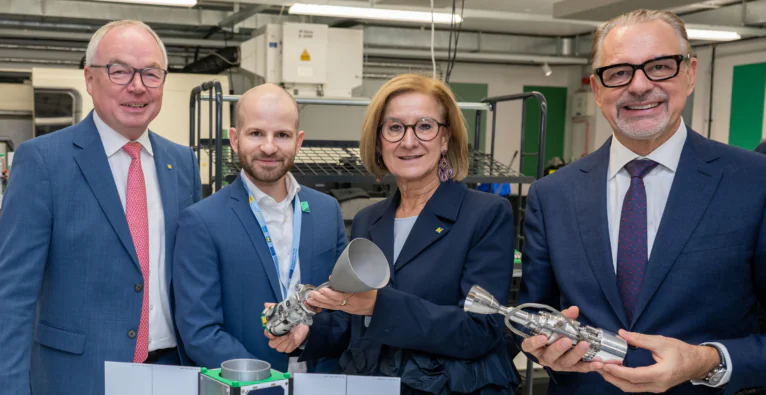
V.l.n.r. LH Stv. Stephan Pernkopf, COO Gate Space Johannes Pammer, Landeshauptfrau Johanna Mikl-Leitner, ESA-Generaldirektor Josef Aschbacher | © NLK Filzwieser

Die Zukunft des ESA-Phi-Lab Austria ist bis 2031 sicher. Das Land Niederösterreich und die ESA (über den Bund) finanzieren den Space Hub in Schwechat mit 4,4 bzw. 5,2 Millionen Euro, wie bei den Austrian Space Days bekanntgegeben wurde. Somit können weitere Unternehmen gefördert werden. Ziel für die Förderperiode ab 2028 ist, neuartige Raumfahrttechnologien schneller vom Prototyp in die industrielle Produktion zu bringen.

Unabhängigkeit und Wertschöpfung

Aufgrund der geopolitischen Lage sei es zentral, mit der „Konkurrenz aus den USA und Asien mithalten zu können“, sagt Landeshauptfrau Johanna Mikl-Leitner. Sie präzisiert: „Wenn wir die Schlüsseltechnologien nicht in der Hand haben, dann steigt unsere Abhängigkeit sowohl politisch, aber vor allem auch wirtschaftlich. Was das heißt, haben wir in den letzten Jahren hautnah zu spüren bekommen.“

Außerdem sieht sie eine Chance für den Wirtschaftsstandort Österreich: „Wir erwarten uns neue Jobs, neue Unternehmen und dadurch auch neue Wertschöpfung, aber vor allem auch Wohlstand in der Zukunft.“ Während andere Branchen laut Mikl-Leitner wegen der wirtschaftlichen Lage verloren gingen, habe die Raumfahrt Potential. „Es gibt in der Raumfahrt ein Wachstum von zehn Prozent pro Jahr. Raumfahrttechnologie und auch Bahntechnologie sind die am schnellsten wachsenden Bereiche weltweit und da wollen wir natürlich auch mit dabei sein.“

LH-Stellvertreter Stephan Pernkopf betont: „Die Verlängerung des ESA-Phi-Lab ist wichtig, um zu zeigen, dass wir auch in angespannten Budgetzeiten in Zukunftstechnologien investieren.“

Vier Ausschreibungen, mehr als 150 Einreichungen

Seit seiner Einführung im Jahr 2024 gab es vier Ausschreibungsrunden, in denen insgesamt über 150 Projekte eingereicht wurden. Einreichungen seien weiterhin laufend möglich. Die Förderung betrage zwischen 200.000 und 500.000 Euro die Projekte würden 12 bis 24 Monate begleitet werden. Der Schwerpunkt liege auf Upstream-Technologien, also der Hard- und Software für Satelliten und Raumfahrzeuge und ihren Betrieb. Das Programm verbindet die Finanzierung mit Unterstützung u. a. bei Geschäftsmodellen, Marktanalyse und Skalierung.

Im ESA Phi-Lab Austria werden aktuell 13 Projekte umgesetzt. Dabei sind Firmen wie Peak Technology, R-Space oder auch Gate Space beteiligt. Letztere designte einen Satelliten, der im Februar nächsten Jahres von SpaceX in den Orbit geschossen werden soll. Der Beaconsat ist Österreichs erster Militärsatellit und soll Angriffe auf Navigationssignale sichtbar machen.

Der Beatconsat (Bildmitte) wurde von Gate Space im Auftrag des Verteidigungsministeriums entwickelt. | © brutkasten

Auf Space Factory folgt Ausbau von Space Hub

Im Sommer dieses Jahres wurde die Space Factory, eine Infrastruktur für Prototyping und Tests, gegründet (brutkasten berichtete). Nun folgt der Ausbau des Space Hubs, um Platz für mehr Firmen zu schaffen. Aktuell sind dort zehn Unternehmen tätig. „Als österreichischer Generaldirektor bin ich wirklich sehr beeindruckt, wie dynamisch die Szene hier ist, wie schnell sich das aufbaut und wie vorwärtsschauend die Region Niederösterreich, aber Österreich insgesamt ist. Die Industrie ist aufgewacht und sehr aktiv. Das rennt jetzt“, sagt ESA-Generaldirektor Josef Aschbacher.

Space Region Lower Austria

In Niederösterreich möchte man „Raumfahrt weiterdenken“ und arbeitet daher an der Initiative „Space Region Lower Austria“. Von Seibersdorf über Wiener Neustadt bis zum Flughafen Wien-Schwechat sollen Forschungseinrichtungen und Unternehmen besser vernetzt werden und unter einer Dachmarke auftreten. „Wir stehen für Raumfahrttechnologie, wir wollen im internationalen Wettbewerb auch mitspielen können. Wir wollen uns von den USA und letztendlich auch von Asien abheben können“, sagt Mikl-Leitner.

Toll dass du so interessiert bist!
Hinterlasse uns bitte ein Feedback über den Button am linken Bildschirmrand.
Und klicke hier um die ganze Welt von der brutkasten zu entdecken.

brutkasten Newsletter

Aktuelle Nachrichten zu Startups, den neuesten Innovationen und politischen Entscheidungen zur Digitalisierung direkt in dein Postfach. Wähle aus unserer breiten Palette an Newslettern den passenden für dich.

Montag, Mittwoch und Freitag

AI Summaries

RBI Elevator Lab: New startup search fields for the second batch

AI Kontextualisierung

Welche gesellschaftspolitischen Auswirkungen hat der Inhalt dieses Artikels?

Leider hat die AI für diese Frage in diesem Artikel keine Antwort …

RBI Elevator Lab: New startup search fields for the second batch

AI Kontextualisierung

Welche wirtschaftlichen Auswirkungen hat der Inhalt dieses Artikels?

Leider hat die AI für diese Frage in diesem Artikel keine Antwort …

RBI Elevator Lab: New startup search fields for the second batch

AI Kontextualisierung

Welche Relevanz hat der Inhalt dieses Artikels für mich als Innovationsmanager:in?

Leider hat die AI für diese Frage in diesem Artikel keine Antwort …

RBI Elevator Lab: New startup search fields for the second batch

AI Kontextualisierung

Welche Relevanz hat der Inhalt dieses Artikels für mich als Investor:in?

Leider hat die AI für diese Frage in diesem Artikel keine Antwort …

RBI Elevator Lab: New startup search fields for the second batch

AI Kontextualisierung

Welche Relevanz hat der Inhalt dieses Artikels für mich als Politiker:in?

Leider hat die AI für diese Frage in diesem Artikel keine Antwort …

RBI Elevator Lab: New startup search fields for the second batch

AI Kontextualisierung

Was könnte das Bigger Picture von den Inhalten dieses Artikels sein?

Leider hat die AI für diese Frage in diesem Artikel keine Antwort …

RBI Elevator Lab: New startup search fields for the second batch

AI Kontextualisierung

Wer sind die relevantesten Personen in diesem Artikel?

Leider hat die AI für diese Frage in diesem Artikel keine Antwort …

RBI Elevator Lab: New startup search fields for the second batch

AI Kontextualisierung

Wer sind die relevantesten Organisationen in diesem Artikel?

Leider hat die AI für diese Frage in diesem Artikel keine Antwort …

RBI Elevator Lab: New startup search fields for the second batch