
28.06.2019

The investors‘ new favourite playing field

The supply of capital for Digital Health and HealthTech startups is currently growing enormously in Austria. More and more VC funds are specializing in the apparently hottest topic in the ecosystem.
/artikel/digital-health-and-healthtech-investors-austria
Digital Health and HealthTech - more Investors in Austria
(c) fotolia.com - itchaznong

Boldly one might say: HealthTech is the new FinTech – at least concerning the interest of Austrian investors. The country’s startup ecosystem is currently experiencing a wave of new Digital Health and HealthTech initiatives. And with this wave, new VC funds are coming onto the scene that specialize in the industry.

+++ Zur deutschen Version des Artikels +++

Option for „small“ investors

In contrast to the thematically related biotech and life science sectors, investments in the digital health and health tech sectors are affordable for „small“ investors (i.e. basically every VC in Austria). With their often purely digital solutions, startups initially have a capital requirement comparable to that in typical startup industries such as FinTech. In contrast to the biotech sector, where, for instance, the development of new therapeutic approaches can cost two to three digit million euro amounts, digital health startups can often reach market maturity with six to seven digit seed investments.

Pioneer Hansi Hansmann supports new fund

One of those who started to invest in the industry at a very early stage is Austria’s best-known business angel Hansi Hansmann – also due to his personal biography. Having acquired shares of startups like mysugr, Diagnosia, Vamida and Kiweno and in the broader sense Runtastic (some of them already had their exit), he showed his affinity for the field again and again. Hansmann is now supporting a new digital health fund of the former Speedinvest HealthTech specialist Lucanus Polagnoli and the serial entrepreneur Michael Ströck. And other „celebrities“ of the Austrian scene, such as the Runtastic founders, also support the new fund, about which no details are known so far.

Apex: 50 million euros for Digital Health and HealthTech

The known information on the planned new Apex Digital Health fund is somewhat more precise. The Viennese investment company Apex Ventures is thus setting up its second seed investment fund. While the first fund was generally aimed at the broader deeptech field and held 16 million euros, the current fundraising for the HealthTech fund is expected to generate a total of 50 million euros. The investment activities will focus on the DACH and CEE regions. Gordon Euller, a physician with entrepreneurial and business consulting experience, is the person in charge.

Uniqa: Investment Focus and Startup Program

For several months now, the investment arm of Austria’s second largest insurer, the Uniqa Group, has been placing a clear focus on the emerging digital health and health tech industry. The corporate VC fund Uniqa Ventures, also endowed with 50 million euros, has recently massively increased its investment activity in the industry. One of the „startup sources“ is an initiative led by Uniqa that runs its own startup accelerator: the Health Hub Vienna.

Institutional players discover the topic

The programme launched in 2018 has recently been followed by other initiatives – by institutional players. In Vienna, for example, the City, the Chamber of Commerce, the Federation of Austrian Industry and the Social Insurance umbrella organization announced their own programme. And in Linz, the incubator tech2b, which is operated by the province of Upper Austria, launched its own sector-specific incubator programme.

A basic problem is still unsolved

All these monetary and non-monetary initiatives certainly create unprecedented potential for Austria’s Digital Health and HealthTech industry. However, they don’t yet solve a fundamental problem of the domestic startup ecosystem: follow-up financing. Apex Digital Health and Uniqa Ventures have admittedly indicated that they will each reserve at least twice the amount of the seed financing rounds for subsequent investments. But it will need more to establish Austria as the global focal point of the industry. In terms of capital for the really large expansion, Austrian HealthTechs will therefore have to continue to watch out abroad.

Redaktionstipps
Deine ungelesenen Artikel:
21.10.2026

Biotech Summit Austria: Der Wille zum Champion ist da – das Kapital noch nicht

Kommentar: Karin Hofelich war beim Biotech Summit Austria in Innsbruck und fragt: Kommt das Geld aus dem neuen Dachfonds auch bei Biotech-Unternehmen an?
/artikel/biotech-summit-austria-der-wille-zum-champion-ist-da-das-kapital-noch-nicht
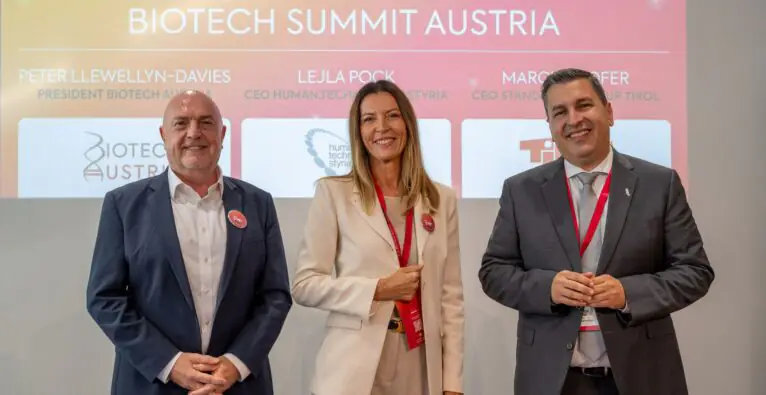
V.l.n.r.: Peter Llewellyn-Davies (Präsident BIOTECH AUSTRIA), Lejla Pock (CEO Human.technology Styria), Marcus Hofer (CEO Standortagentur Tirol) © BIOTECH AUSTRIA

Rund 250 Teilnehmer:innen aus zwölf Ländern, zwei Tage in Innsbruck, ein Motto: „Start up, Scale up, Step up!“ Mit vielen neuen Kontakten und einem guten Gefühl bin ich nach Hause gefahren und mit einer offenen Frage: Die österreichische Biotech-Branche ist so gut vernetzt wie nie, aber woher kommt  künftig das Geld, damit aus exzellenter Forschung Unternehmen werden, die in Europa groß werden?

Am Wissen fehlt es nicht. Ob Europa in der Biotechnologie mitspielt, entscheidet sich an der Finanzierung der Wachstumsphase.

Europa zwischen den USA, Golfstaaten und China

Der Schwerpunkt des Summits lag auf dem Scaleup, also auf dem Schritt vom Startup zum international wachsenden Unternehmen.

Ein Bild für die Zukunft der Pharmatrends zeichnete Claudio Albrecht, ehemaliger CEO der Stada AG. Er sprach darüber, wie Geopolitik, neue Technologien und sich wandelnde Gesundheitssysteme die Pharmaindustrie bis 2035 prägen könnten. Besonders hervorgehoben hat er dabei die Transformation Chinas von einer Service-Industrie zu einem Innovationsmotor sowie die Dynamik in den Golfstaaten. Europa widmete er keine eigene Folie in seiner Präsentation, was vom Publikum hinterfragt wurde. Es wirft die Frage auf, welchen Stellenwert Europa künftig im globalen Wettbewerb überhaupt noch spielen wird.

(c) Hofelich – Claudio Albrecht gab einen Ausblick in die Zukunft.

 Ein Champion, der nicht auswandern muss

Den Gegenentwurf lieferte Karl Nehammer, Vizepräsident der Europäischen Investitionsbank (EIB) und ehemaliger Bundeskanzler. Besonders in Erinnerung geblieben ist mir vor allem ein Satz: „The next champion should not need to leave Europe in order to become a global champion.“ 

(c) Hofelich – Karl Nehammer, Vizepräsident der Europäischen Investitionsbank (EIB).

Das Ziel ist ambitioniert und gerade in der Biotechnologie bislang schwer erreichbar. Entwicklungszyklen dauern hier i. d. R. mehr als ein Jahrzehnt. 

Der Startup- & Scaleup-Dachfonds: eine gute Nachricht mit Fragezeichen

Für die Branche besonders interessant war die Diskussion über den geplanten österreichischen Dachfonds. Stefan Haubner, Founding Partner bei APEX Ventures, widmete sich der Frage, ob Europa ein eigenes Modell für Venture Capital braucht. Dabei ging es auch um den österreichischen Fund-of-Funds. 

Der Dachfonds soll Anfang 2027 starten. Der Staat steuert 100 Mio. Euro bei, institutionelle Investoren sollen weitere 400 Mio. Euro bringen. Das ist ein wichtiges Signal. Weil es ein Dachfonds ist, investiert er aber nicht direkt in Unternehmen, sondern in andere Fonds.

Wie viel von diesem Geld tatsächlich bei Biotech-Unternehmen ankommt, ist derzeit offen.

Life Sciences brauchen Investoren mit Fachwissen und langem Atem. Davon gibt es in Österreich nur wenige. Wenn der Dachfonds vor allem in Generalisten-Fonds fließt, könnte die Biotechnologie leer ausgehen.

Tirol zeigt, wie Standortarbeit aussieht

Auch organisatorisch war der Summit ein Vorzeigeprojekt. Veranstaltet wurde der Summit von BIOTECH AUSTRIA, Human.technology Styria und der Standortagentur Tirol. Vor Ort vertreten waren Peter Llewellyn-Davies, Präsident von BIOTECH AUSTRIA, Marcus Hofer, CEO der Standortagentur Tirol, und Lejla Pock, CEO von Human.technology Styria. Äußerst charmant moderiert hat Damita Pressl.

Die Villa Blanka hoch über Innsbruck bot eine außergewöhnliche Kulisse; ebenso das Gala-Dinner am Abend in der Rooftop-Bar des Hotels aDLERs. Begeistert zeigten sich auch die Teilnehmer:innen, die am Vortag im Rahmenprogramm die Skisprungschanze Bergisel besichtigt hatten. Ich selbst habe mir am Dienstagmorgen den Health Hub Tirol angesehen. Das Technologiezentrum ist seit knapp einem Jahr in Betrieb und bietet noch freie Flächen. Das ist die Art Standortpolitik, die wirkt: Infrastruktur, Netzwerk und ein Treffpunkt, an dem Forschung, Investor:innen und Politik tatsächlich ins Gespräch kommen.

Was es jetzt braucht

Der Summit hat gezeigt, dass die Branche sich der Herausforderungen bewusst ist und weiß, was zu tun ist.

Der nächste Champion muss nicht auswandern. Aber dafür muss das Kapital vor Ort stärker mobilisiert werden. 

Der fünfte Biotech Summit Austria findet am 21. und 22. Oktober 2027 in Graz statt. Bis dahin wissen wir mehr darüber, ob der Dachfonds auch der Biotechnologie hilft.


Disclaimer: Karin Hofelich ist Life Science Lead beim brutkasten-Schwestermagazin VentureCapital. Das VC Magazin war Medienpartner des Summits.

Toll dass du so interessiert bist!
Hinterlasse uns bitte ein Feedback über den Button am linken Bildschirmrand.
Und klicke hier um die ganze Welt von der brutkasten zu entdecken.

brutkasten Newsletter

Aktuelle Nachrichten zu Startups, den neuesten Innovationen und politischen Entscheidungen zur Digitalisierung direkt in dein Postfach. Wähle aus unserer breiten Palette an Newslettern den passenden für dich.

Montag, Mittwoch und Freitag

AI Summaries

The investors‘ new favourite playing field

AI Kontextualisierung

Welche gesellschaftspolitischen Auswirkungen hat der Inhalt dieses Artikels?

Leider hat die AI für diese Frage in diesem Artikel keine Antwort …

The investors‘ new favourite playing field

AI Kontextualisierung

Welche wirtschaftlichen Auswirkungen hat der Inhalt dieses Artikels?

Leider hat die AI für diese Frage in diesem Artikel keine Antwort …

The investors‘ new favourite playing field

AI Kontextualisierung

Welche Relevanz hat der Inhalt dieses Artikels für mich als Innovationsmanager:in?

Leider hat die AI für diese Frage in diesem Artikel keine Antwort …

The investors‘ new favourite playing field

AI Kontextualisierung

Welche Relevanz hat der Inhalt dieses Artikels für mich als Investor:in?

Leider hat die AI für diese Frage in diesem Artikel keine Antwort …

The investors‘ new favourite playing field

AI Kontextualisierung

Welche Relevanz hat der Inhalt dieses Artikels für mich als Politiker:in?

Leider hat die AI für diese Frage in diesem Artikel keine Antwort …

The investors‘ new favourite playing field

AI Kontextualisierung

Was könnte das Bigger Picture von den Inhalten dieses Artikels sein?

Leider hat die AI für diese Frage in diesem Artikel keine Antwort …

The investors‘ new favourite playing field

AI Kontextualisierung

Wer sind die relevantesten Personen in diesem Artikel?

Leider hat die AI für diese Frage in diesem Artikel keine Antwort …

The investors‘ new favourite playing field

AI Kontextualisierung

Wer sind die relevantesten Organisationen in diesem Artikel?

Leider hat die AI für diese Frage in diesem Artikel keine Antwort …

The investors‘ new favourite playing field